.png)
Thailand vs. Vietnam: Two Markets Shaping the Future of Business in Southeast Asia
Southeast Asia is no longer simply the next destination considered by international companies looking for growth. For many of them, the region is now an integral part of their strategy.
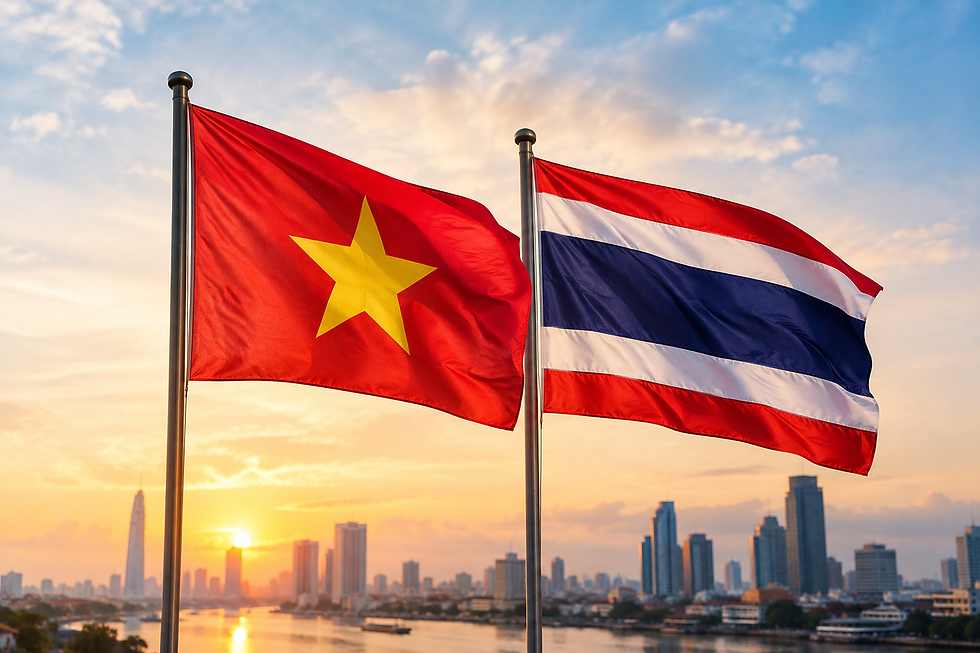
Fast-growing consumer markets, expanding industrial capabilities, a young workforce, and an increasingly connected economic environment: the arguments are numerous. But establishing a presence in Southeast Asia is not simply about choosing the country with the lowest costs or the one with the fastest-growing GDP.
Take Thailand and Vietnam.
Just over an hour of flight separates them, but the business environment can seem surprisingly different. Both countries attract international investment, are developing their infrastructure, and are seeking to play an increasingly important role in global supply chains.
What changes is the stage each economy is at, and what this means for a company looking to expand there.
Two Economies on the Move
Vietnam is moving at a pace that is difficult to ignore.
Its economy grew by 8.18% in the first half of 2026, driven notably by manufacturing, construction, and services. Thailand, meanwhile, is expected to record growth of around 1.8% over the full year.
On paper, the gap is considerable.
But it does not tell the whole story.
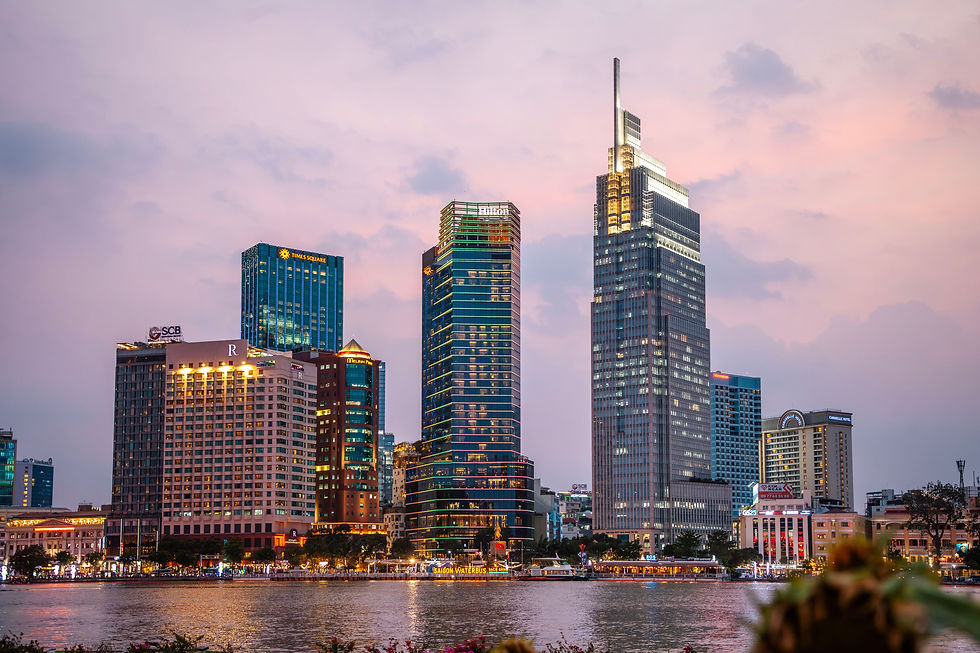
You only need to walk around Ho Chi Minh City to see what an economy in full acceleration looks like. New office towers stand alongside construction sites, international brands continue to arrive, and entire neighborhoods are being transformed by new residential and commercial projects.
Bangkok gives a different impression. The city is already a major international metropolis, with several decades of foreign investment behind it. The challenge is no longer really to build the foundations of an economic hub, but to determine what comes next.
This difference is increasingly reflected in investment.
In the first half of 2026, investment applications in Thailand reached approximately $43.6 billion, particularly in digital infrastructure, data centers, electronics, and automotive. The country is therefore seeking to move its industry toward electric vehicles, automation, robotics, and other higher-value-added activities.
Vietnam is undergoing a different transformation. Its manufacturing industry continues to expand, but investment is gradually moving toward more sophisticated activities, particularly semiconductors, artificial intelligence, and advanced technologies.
The two economies are therefore moving in the same direction, but they are not starting from the same point.
And that changes a lot when it comes to deciding where to locate your teams.
The Real Cost of Establishing a Presence
Cost is generally one of the first criteria considered by a company looking at Southeast Asia.
Vietnam has an obvious advantage here. Living and working in Ho Chi Minh City generally remains cheaper than in Bangkok. Current comparisons estimate that Bangkok is around 42% more expensive than Ho Chi Minh City, although the difference depends heavily on the neighborhood and standard of living.
For an expatriate employee, the difference can be significant. Housing, restaurants, transportation, and everyday services remain relatively affordable, while companies can generally build teams at salary levels lower than those found in more mature regional hubs.
But international expansion rarely fails because of the rent.
The most significant costs are often those that are less easily visible in a business plan: finding the right profiles, retaining them, understanding regulations, managing suppliers, solving logistical problems, or simply getting a decision to move forward.
This is where Thailand's maturity becomes particularly relevant.
A company establishing itself in Bangkok enters an environment shaped by several decades of international business activity. Suppliers, professional services, logistics networks, international schools, and infrastructure for expatriates are already largely in place.
Vietnam is rapidly building this same ecosystem. This dynamic creates enormous opportunities, but it also sometimes requires companies to take part themselves in building the environment in which they will operate.
No model is necessarily better.
They simply require a different ability to manage complexity.
A Question of Talent as Much as Salaries
The same logic applies to the labor market.
Vietnam's relatively young population is one of its main strengths. For companies experiencing rapid growth, access to a large and increasingly skilled workforce represents a considerable advantage.
But growth also creates its own competition.
Experienced managers, engineers, bilingual professionals, and people accustomed to international environments are increasingly sought after. As multinationals establish themselves in Vietnam, these profiles naturally become harder to attract.
Thailand benefits from another advantage: several decades of multinational presence have helped develop a workforce already familiar with the standards of international companies, particularly in automotive, electronics, industry, and services.
For a company looking to establish a regional team or bring in international executives, this experience can considerably reduce the friction associated with entering a new market.
But Thailand faces another challenge: there are simply fewer young workers entering the labor market.
The aging population is gradually becoming a major economic issue, while Vietnam still benefits from a younger demographic structure.
For a company thinking in terms of three years, the difference may be secondary.
For one building a twenty-year strategy, it becomes much more interesting.
And Then There Is Everything That Doesn't Fit in an Excel Spreadsheet
Economic statistics help us understand part of a market. They do not tell us how business is actually done there.
A company can have the right product, the right price, and a solid business plan and still encounter difficulties if it does not understand how professional relationships work locally.
In both Thailand and Vietnam, trust, personal relationships, and hierarchy play an important role.
For a Western executive accustomed to very direct negotiations, the pace can therefore come as a surprise.
In Thailand, preserving harmony and avoiding direct confrontation are particularly important. A meeting may seem very positive without necessarily leading immediately to a decision.
In Vietnam, relationships also play a central role, but the environment, particularly in Ho Chi Minh City, can appear more entrepreneurial and commercially fast-paced.
In both cases, the first meeting is not necessarily intended to close a contract.
It may simply be about determining whether the two people want to work together.
For companies sending employees abroad, this cultural adaptation can ultimately be just as important as understanding taxation or labor law.
Bangkok or Ho Chi Minh City?
It may be by looking at the two cities that the differences become most concrete.
Bangkok has the infrastructure of an international metropolis that has played this role for several decades.
Multinational headquarters, hotels, hospitals, international schools, professional services, and transportation form a particularly developed ecosystem.
Ho Chi Minh City gives more of an impression of a city in acceleration.
Its business community is young, ambitious, and increasingly international. New real estate projects are transforming the urban landscape, foreign companies continue to arrive, and local players are rapidly becoming more sophisticated.
For expatriate employees, this difference is also felt in everyday life.
In Bangkok, many of the services expected by an international population are already well established.
In Ho Chi Minh City, they are developing at an impressive pace, in a city where new neighborhoods, restaurants, residences, and services are constantly appearing.
For an employer, this ultimately creates two different relocation experiences.
In one case, employees need to be supported in an already highly developed international city.
In the other, they need to be supported in a city that is still evolving rapidly.
And this dimension is beginning to become an integral part of the business decision.
The Choice May Not Be as Binary
The development of both markets is also making the boundary between them increasingly interesting.
Vietnam is now investing in sectors once associated with more mature industrial economies. Thailand, for its part, is positioning itself in technological activities that were once more concentrated in the major Asian hubs.
Both countries are investing in digital infrastructure, seeking to attract higher-value-added industrial activities, and aiming to become increasingly important regional bases for international companies.
Competition is therefore no longer solely about the price of a factory or the level of a tax incentive.
It is about the combination of infrastructure, talent, market access, technology, and quality of life needed to accommodate the companies of tomorrow.
This is also what makes the two markets potentially complementary.
A company could very well use Thailand as a regional base while developing part of its industrial or sourcing activities in Vietnam.
A technology company could have a sales team in Bangkok and develop part of its technical teams in Ho Chi Minh City.
An industrial company could rely on Thailand's automotive and electronics ecosystem while benefiting from the development of Vietnam's production capabilities.
The question is therefore not necessarily about choosing one country over the other.
Beyond the Numbers
It is tempting to reduce the decision to a simple Excel spreadsheet.
Salary costs. Office prices. GDP growth. Taxation. Investment volumes.
All these figures matter, but they only tell part of the story.
The real test begins once the company has established itself. A competitive salary is of little use if the company cannot retain the talent it needs. An inexpensive office loses its appeal if commuting becomes a real daily challenge. And even the best investment conditions will not be enough to compensate for a business relationship that never manages to develop.
The question becomes even more important when it comes to relocating international teams. Where will they live? Can they integrate easily? Do they have access to the schools, healthcare, and services they need? Can they travel easily around the region?
These are not simply HR considerations. They can directly influence a company's ability to attract the right profiles, retain them, and ultimately grow its business.
This is also when Bangkok and Ho Chi Minh City reveal two very different sides of the same regional opportunity.
Bangkok offers the stability of an already established international hub. Ho Chi Minh City offers the energy of a market that continues to accelerate.
But neither is standing still.
Vietnam is gradually building new layers of its economy, attracting investment in technology, advanced industry, and high-value-added services. Thailand, meanwhile, is transforming an economy that already has strong industrial and international foundations, particularly by focusing on electric vehicles, digital infrastructure, and automation.
For companies, this ultimately creates a fairly simple question:
Should you enter a market while it is still being built, or join an established market that is preparing to enter a new phase?
There is no universal answer.
And that is probably the most important point. The best market for a company is not necessarily the one with the most impressive figures. It is the one where its ambitions, its teams, and the trajectory of the market come together at the right time.
For some companies, that meeting point is already in Bangkok.
For others, it is in Ho Chi Minh City.
And for those truly thinking on a regional scale, the answer may well be: both.


Comments